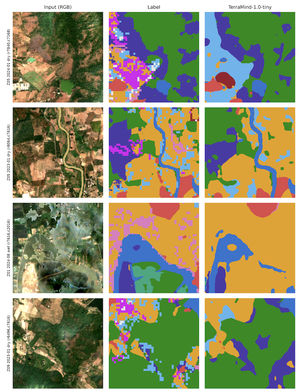
Geospatial foundation models (GFMs) offer powerful representations for Earth observation, yet effective adaptation to dense prediction tasks remains underexplored. We introduce KAO-TerraMind, a targeted adaptation framework that systematically investigates three factors, backbone optimisation, loss design, and decoder architecture. Through controlled ablations, we show that decoder-focused adaptation achieves the best performance, improving overall accuracy from 78.44% to 78.90%, mIoU from 40.82% to 41.13%, F1 from 52.57% to 52.80%, and mAP from 52.63% to 53.03%. In contrast, stronger backbone optimisation alone provides no measurable mIoU improvement, while an increased Dice loss benefits under-represented classes. These findings highlight decoder design and multi-level feature integration as effective strategies for adapting geospatial foundation models to dense prediction. We will release the finetuning code and evaluation protocol to facilitate reproducible research.