CHULA-OCR: Uncertainty-Aware Robust OCR for Digitizing Land Title Deeds
Abstract
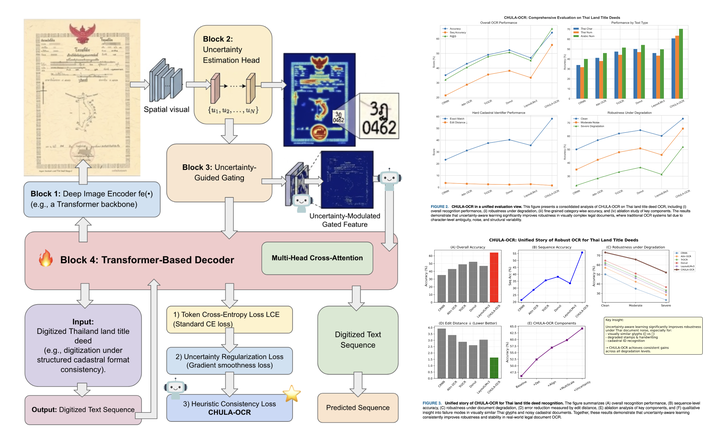
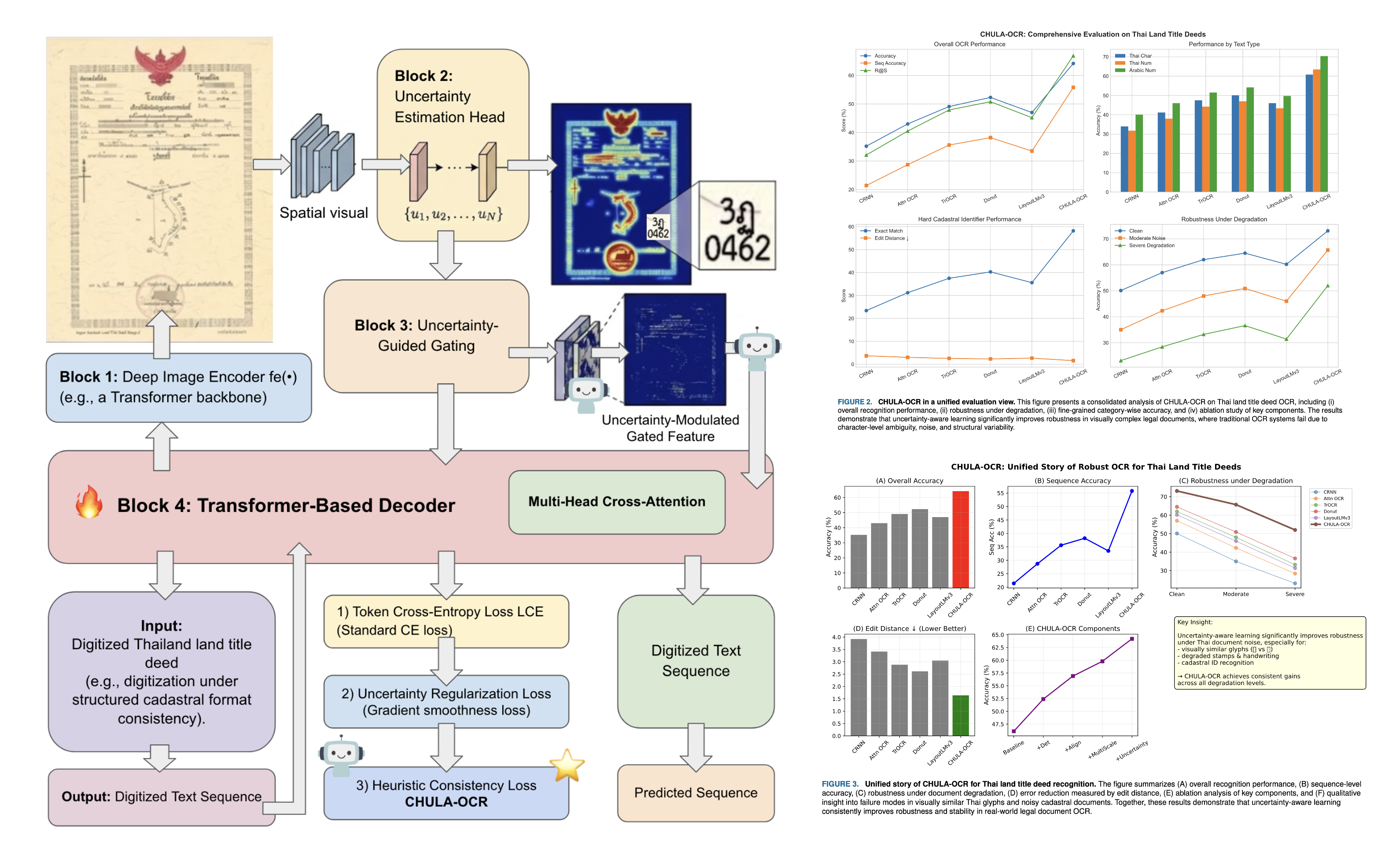
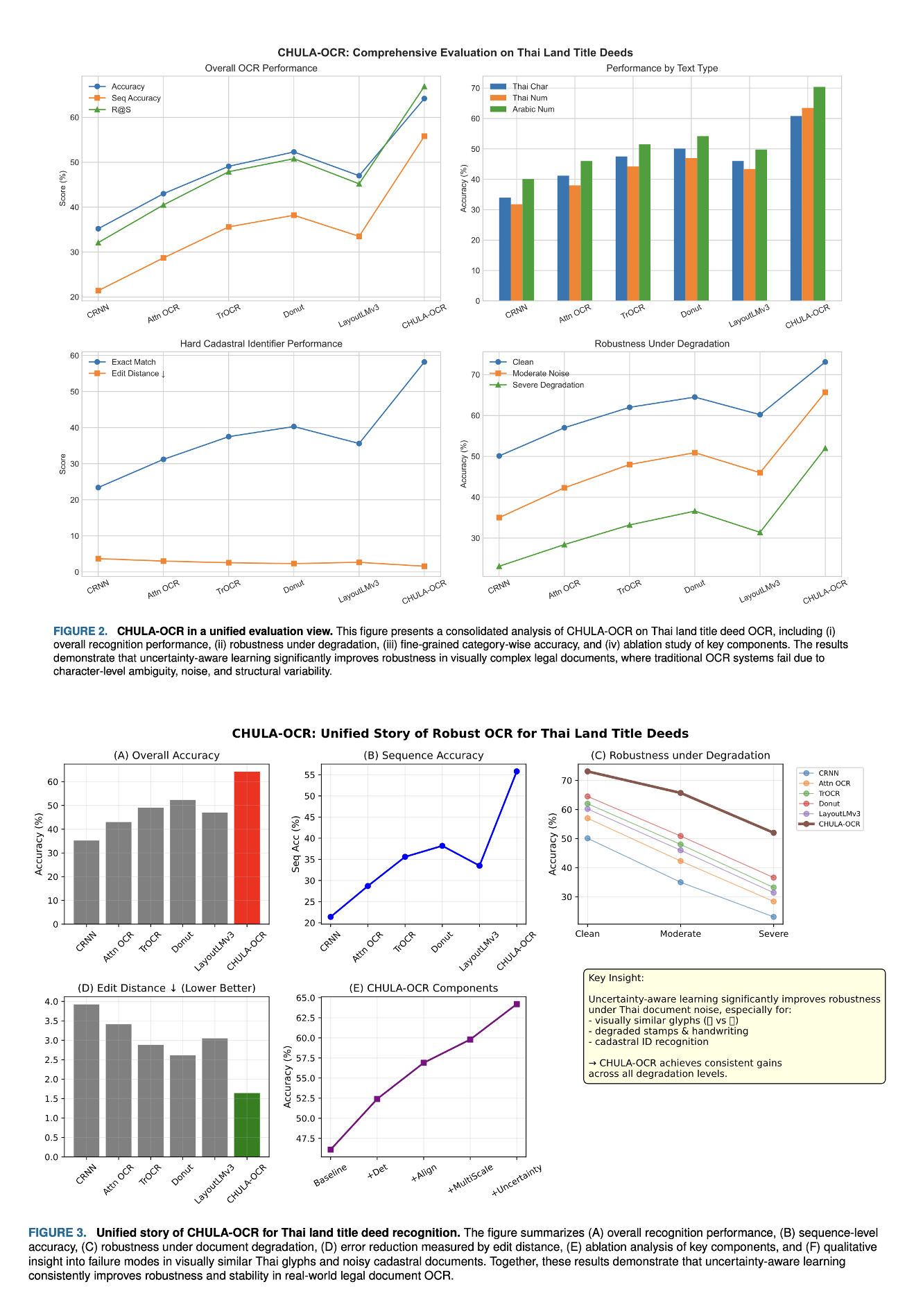
Optical Character Recognition (OCR) in real-world legal documents remains a challenging problem due to severe visual degradation, complex layouts, and high character ambiguity. This challenge is particularly evident in Thai land title deeds, where handwritten annotations, official stamps, and low-quality scans substantially reduce recognition reliability. In this paper, we propose CHULA-OCR, an uncertainty-aware OCR framework designed to improve robustness in challenging document environments. The key idea is to explicitly model prediction uncertainty during training through an entropy-guided weighting mechanism, enabling the model to emphasize reliable character regions while reducing the influence of ambiguous or noisy visual evidence. To support this study, we construct a large-scale Thai land title deed dataset collected from real administrative documents, capturing diverse document conditions including printed text, handwriting variation, degradation artifacts, and complex cadastral structures. Extensive experiments demonstrate that CHULA-OCR consistently outperforms strong baselines, including CRNN, Transformer-based OCR models, and OCR-free document understanding approaches, across both standard and highly degraded recognition scenarios. Qualitative analyses further show reduced character-level confusion, particularly for visually similar Thai glyphs and ambiguous numerical identifiers. Beyond improving recognition accuracy, CHULA-OCR provides a practical foundation for large-scale land document digitization by introducing uncertainty estimation that can identify unreliable predictions for human verification. Rather than replacing expert review in legal workflows, the proposed framework supports human-in-the-loop document processing by reducing manual transcription effort and improving the prioritization of difficult recognition cases. These results demonstrate the potential of uncertainty-aware OCR for assisting reliable digital transformation of large-scale land administration archives.

Teerapong Panboonyuen
My research focuses on leveraging advanced machine intelligence techniques, specifically computer vision, to enhance semantic understanding, learning representations, visual recognition, and geospatial data interpretation.