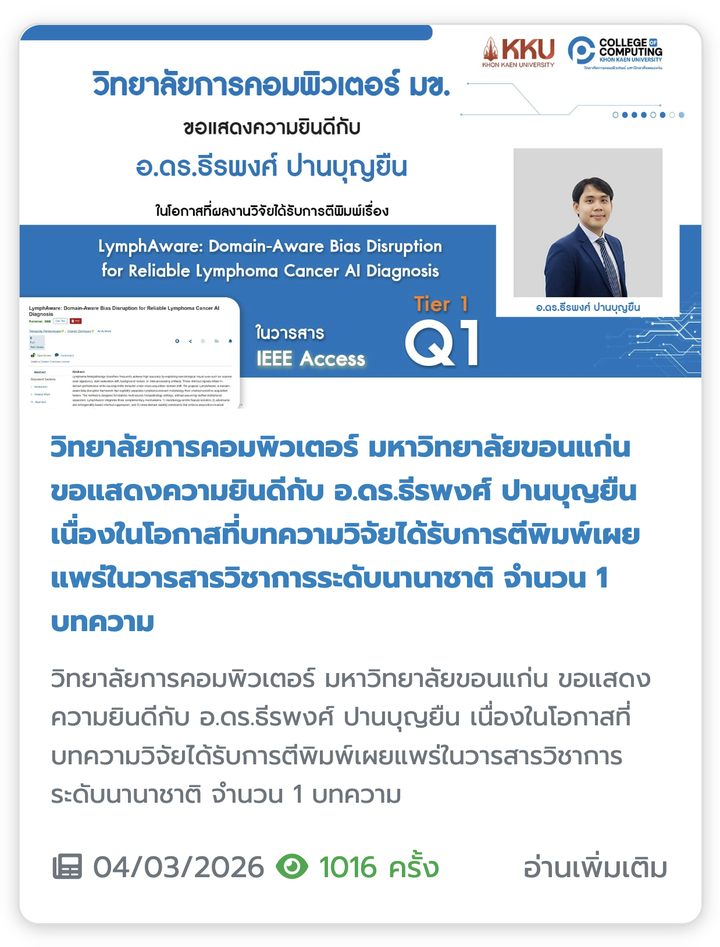
 LymphAware, Enhancing AI Reliability in Lymphoma Diagnosis
Abstract
LymphAware presents a tri-path deep learning architecture to separate critical morphological features of cancer cells from spurious signals such as scanning or staining variations. This approach enhances cross-domain robustness, reduces prediction errors, and produces attribution maps aligned with true pathology. The framework demonstrates the potential of clinically reliable AI in supporting physicians for more accurate and safe lymphoma diagnoses, with positive implications for healthcare systems by minimizing diagnostic errors and improving timely patient treatment.

Research Highlight
The College of Computing, Khon Kaen University, has officially featured the research work of Dr. Teerapong Panboonyuen, recognizing his contribution to advancing Artificial Intelligence for medical diagnosis. This recognition highlights an important milestone in the development of trustworthy AI technologies designed to support clinical decision-making and improve healthcare outcomes.
The featured research introduces LymphAware, a novel AI framework designed to improve the accuracy and reliability of lymphoma cancer diagnosis from histopathology images. Histopathological analysis plays a critical role in cancer diagnosis, yet variations in slide preparation, staining processes, and scanning devices often introduce unwanted signals that can mislead machine learning models.
Addressing the Shortcut Bias Problem
Many AI models unintentionally learn shortcut patterns from irrelevant image artifacts instead of focusing on true pathological features. These artifacts may include:
- Differences in color caused by staining procedures
- Variations from scanning equipment
- Background textures unrelated to cancer pathology
While such models may appear highly accurate during laboratory testing, they can fail when deployed in real clinical environments where data characteristics vary significantly across hospitals.
To address this challenge, LymphAware introduces a Tri-Path Deep Learning Architecture designed to explicitly separate meaningful cancer morphology from spurious signals.
Key Innovations of LymphAware
The proposed framework focuses on three major objectives:
- Extract clinically meaningful morphological features from lymphoma cells while isolating irrelevant artifacts.
- Suppress artificial signals originating from slide preparation, staining, or scanning processes.
- Enhance cross-domain robustness, enabling the model to perform consistently across datasets from different medical institutions.
By focusing on domain-aware learning, the system helps ensure that AI predictions are based on true pathological evidence rather than accidental correlations.
Experimental Impact
Extensive experiments demonstrate that the proposed approach:
- Improves robustness against domain shift across different datasets
- Reduces misclassification rates in lymphoma diagnosis
- Produces attribution maps that align closely with real pathological regions observed by medical experts
These results highlight the potential of clinically reliable AI systems capable of supporting physicians in making more accurate and trustworthy diagnostic decisions.
Advancing AI for Healthcare
This research represents an important step toward the development of clinically trustworthy artificial intelligence. By addressing reliability challenges in medical imaging, LymphAware contributes to the broader goal of integrating AI safely into healthcare systems.
Such technologies have the potential to:
- Reduce diagnostic variability
- Assist pathologists in complex case analysis
- Improve early detection and treatment planning for cancer patients
Ultimately, the work demonstrates how advanced AI research can contribute to improving public health and supporting medical professionals worldwide.
Official News Coverage
This research recognition has been officially announced by the College of Computing, Khon Kaen University through their institutional communication channels.

Learn More
Readers interested in exploring the full project, technical details, and research materials can visit the official project page:

Teerapong Panboonyuen
My research focuses on leveraging advanced machine intelligence techniques, specifically computer vision, to enhance semantic understanding, learning representations, visual recognition, and geospatial data interpretation.