LymphAware: Domain-Aware Bias Disruption for Reliable Lymphoma Cancer AI Diagnosis
Abstract
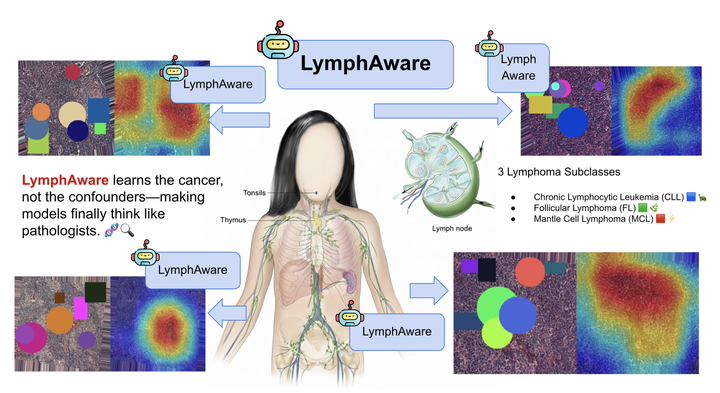
Lymphoma histopathology classifiers frequently achieve high accuracy by exploiting non-biological visual cues such as scanner color signatures, stain-saturation drift, background texture, or slide-processing artifacts. These shortcut signals inflate in-domain performance while causing brittle behavior under cross-acquisition domain shift. We propose LymphAware, a domain-aware bias disruption framework that explicitly separates lymphoma-relevant morphology from shortcut-sensitive acquisition factors. The method is designed for realistic multi-source histopathology settings, without assuming verified institutional separation. LymphAware integrates three complementary mechanisms, (1) morphology-centric feature isolation, (2) adversarial and orthogonality-based shortcut suppression, and (3) cross-domain stability constraints that enforce acquisition-invariant representations. Each component addresses a distinct shortcut failure mode, avoiding redundant architectural complexity. To expose latent shortcut dependence, we introduce artifact-shift perturbations that simulate staining and scanner variability and enforce counterfactual consistency during training. Evaluated on a heterogeneous lymphoma histopathology benchmark, LymphAware consistently improves cross-domain robustness, degrades gracefully under loss-weight variation, and yields attribution maps aligned with pathology-relevant regions. We emphasize that these attributions reflect associative alignment rather than proven causal inference. These results highlight the importance of representation-level shortcut disruption for reliable and clinically meaningful lymphoma diagnosis.


You can explore the full LymphAware project at 👉 https://kaopanboonyuen.github.io/LymphAware/
The official implementation is publicly available at 👉 https://github.com/kaopanboonyuen/LymphAware
Unlike conventional histopathology classifiers that implicitly rely on acquisition-specific shortcuts, LymphAware is designed from the ground up to disentangle morphology from scanner- and stain-induced bias. The repository includes reproducible training pipelines, artifact-shift perturbation modules, and evaluation protocols for cross-domain robustness. Our goal is not merely higher accuracy, but representation-level reliability under realistic domain shift — a necessary step toward clinically trustworthy AI systems.

Teerapong Panboonyuen
My research focuses on leveraging advanced machine intelligence techniques, specifically computer vision, to enhance semantic understanding, learning representations, visual recognition, and geospatial data interpretation.